Lobuche Peak Climbing Base Camp Service

Duration2 Days
Trip GradeDifficult
CountryNepal
Maximum Altitude6090 m
Group Size1-12
StartsLobuche Base Camp
EndsLobuche Base Camp
ActivitiesPeak Climbing
Best TimeSpring and Autumn

Standing at base camp below Lobuche Peak, you already know the easy part is done. The trek got you here, but the summit is a different story. This is where most people start looking for a Lobuche Peak base camp service, not for comfort, but for the technical support needed to actually reach the top. There is no full itinerary from Kathmandu and no guided walk through Sagarmatha National Park included here.

The Lobuche Peak Climbing Base Camp service is just the climb from base camp to the summit and back, with a climbing guide, fixed ropes, and a basic high camp setup. If you are already acclimatized and serious about a Lobuche Peak summit climb, this is the part that decides whether you make it or turn around.

Where exactly is the Lobuche Peak Cllimbing Located?

Lobuche Peak climbing is located in the Khumbu region of Nepal, inside Sagarmatha National Park, the same Himalayan area where Mount Everest is found. It is not far from Lobuche village and sits above the main trekking route that most people take toward Mount Everest. Usually, climbers get there after flying to Lukla and trekking up through places like Namche and the higher valleys.

This area is also where most people start looking for things like Lobuche Peak climbing base camp service or small expeditions in Nepal, because it is close to Everest but still a more accessible peak. It is basically the point where trekking starts feeling like proper climbing, but without the scale of a full Everest expedition.

What does Lobuche Peak Base Camp Service mean?

Lobuche Peak Base Camp Service just means the support starts only from base camp for Lobuche Peak and finishes there too.

Getting to base camp from Kathmandu and trekking through Sagarmatha National Park is not part of it. That part is handled separately, usually as a trek.

Once base camp is reached, a guide helps with the climb, shows the route, fixes ropes where needed, and leads the way up and back down. It is basic support for the actual climbing part, nothing more. So if you want to book base camp service for any peak climbing in Nepal, we as Nepal Trekking Routes are here to assist you.

Lobuche Peak Base Camp Service Highlights 

  • Base camp is basically where everything starts for Lobuche Peak, and anything before that is just getting yourself up there
  • A guide is there the whole time from base camp, not in a fancy way, just someone who knows the route and keeps things moving when it gets steep
  • Fixed ropes are already in place on the hard sections, so it is more about following and not overthinking every step
  • The main idea is simple, get up to the summit and come back down safely, nothing extra or complicated
  • Most people using this are already in the Everest region after the walk in from Lukla and through Sagarmatha National Park
  • It feels less like a packaged service and more like having someone experienced around when the climb actually gets serious

Why Choose Lobuche Peak Climbing Base Camp Service instead of going on your own?

Trying to climb Lobuche Peak on your own sounds brave, but once you are above base camp it quickly gets steep, cold, and technical. That is where a Lobuche Peak base camp service actually makes sense.

A guide is the main reason people go for it. The route is already known, ropes are fixed on the harder sections, and there is no wasting energy trying to figure things out when the altitude is already hitting hard. It just keeps things more straightforward when you are tired.

Most people also get there after walking up from Lukla through Sagarmatha National Park, so you are already a bit drained before the climb even starts. In the end, it is just about not making the Lobuche climb messier than it already is.

Permits Required for Lobuche Peak Base Camp Climbing Service

For a Lobuche Peak base camp climbing service on Lobuche Peak, permits are still required even if the climb starts from base camp. This is still official peak climbing in Nepal, so access is regulated.

The main requirement is the Lobuche Peak climbing permit (NMA permit). This is the main permit that allows any Lobuche Peak climbing expedition in Nepal to go ahead. Without it, the summit climb is not allowed.

You also need the Sagarmatha National Park entry permit because the route lies inside Sagarmatha National Park. Along with that, the Khumbu Pasang Lhamu rural municipality permit is required for entry and movement in the Everest region trekking and climbing area.

There is also a garbage deposit fee, which is standard in mountaineering in Nepal and is refunded if all waste is carried back down properly from the mountain.

If you book with Nepal Trekking Routes, all of these permits are arranged for you in advance. You do not need to worry about collecting anything yourself. 

2 Days Lobuche Peak Climbing Base Camp Service Itinerary

For Lobuche Peak, the summit plan during a Lobuche Peak climbing expedition in Nepal is usually kept simple from base camp. Day one is just a steady walk from base camp up to High Camp. It is not technical, but you feel the altitude more than the distance. Once we reach High Camp, we rest, check gear, and sleep early for the summit push.

Day two is the main climb. We leave very early from High Camp, move up snow slopes, fixed ropes, and the steeper headwall, and reach the summit at about 6,090 meters. After a short break, we come back down the same way to High Camp and usually continue to base camp if conditions are fine.

We as, Nepal Trekking Routes can also adjust the plan depending on weather and overall situation in mountaineering in Nepal.

Why Base Camp Service Matters While Climbing Lobuche Peak

Base camp service on Lobuche Peak starts to feel important only when you are actually up there, not while planning in Kathmandu or even during the trek.

At that altitude, everything slows down a bit. Even simple walking feels heavier. Having someone who already knows the route just means you are not stopping all the time or second guessing where to go next.

It also saves you from wasting energy on small mistakes. You just follow, step by step, instead of thinking too much when your head is already a bit tired from the height.

Most people reach base camp after a long walk up from Lukla through Sagarmatha National Park, so by the time the climb actually starts, there is already some fatigue and tiredness sitting in.

That is really where the support makes sense. It just keeps things from getting unmanaged when the body and altitude are already doing their part in a Lobuche Peak climbing expedition in Nepal.

Lobuche Peak Climbing Base Camp Service Cost

The Lobuche Peak base camp service cost on Lobuche Peak is usually around USD 950. This is just for the climb part from base camp to the summit and back. Getting to base camp from Kathmandu and the trek through Sagarmatha National Park is not included.

What you are really paying for here is a guide who knows the route, handles the rope sections, and leads the way during the summit push. It is a simple mountaineering support in Nepal, nothing extra or fancy.

If someone wants the full setup, like a proper Lobuche Peak climbing expedition in Nepal, then Nepal Trekking Routes can arrange everything from start to finish. That includes permits, trekking, accommodation, food, and the whole logistics. Of course, that version costs more because everything is handled for you instead of just the climbing part.

How does the Lobuche Peak Base Camp Service Work?

The Lobuche Peak base camp service on Lobuche Peak basically starts once the trek is done and base camp is reached. Nothing really happens with it before that.

From base camp, a climbing guide just takes over and leads the way up. The route is already there, so it is not like figuring out directions or anything. On the steeper icy parts there are fixed ropes, and it is mostly just following them and keeping a steady rhythm so you don’t burn out too fast.

Most people also go up to a higher camp before the summit push, then come back down the same way. That part sounds simple when written like this, but at that altitude everything feels slower and ten times heavier than it actually is, especially during a Lobuche Peak climbing expedition in Nepal.

Who should consider Lobuche Peak base camp service?

The Lobuche Peak base camp service on Lobuche Peak honestly starts making sense once you are already out there in the Everest region and you hear from other climbers what the upper part is actually like.

It usually fits people who are fine with long trekking days, no issue there, but when it comes to steep ice and using ropes, they would rather not be figuring it out on their own. Not because they are weak or anything, just because at that point you are already tired and the mountain does not give you much room for mistakes.

A lot of first timers go for it too. Fit people, motivated, but new to proper mountaineering. During a Lobuche Peak climbing expedition in Nepal, once you are above base camp there is not much time to stop and think things through again and again, so having a guide there just keeps things straightforward.

But if someone is thinking this will be comfortable or relaxed, it is not that at all. It is cold, a bit rough, and you are constantly working against the altitude.

Why Book with Nepal Trekking Routes

With Nepal Trekking Routes, you get a local travel company based in Nepal that actually works on these mountains, not from somewhere far away. We provide Lobuche Peak base camp service on Lobuche Peak with experienced climbing guides who know the route well and have real time on these trails. Everything is kept simple and focused on proper support for trekking and mountaineering in Nepal. Your safety and value for money is completely taken as a main priority here.

Itinerary

This is a simple 2 day itinerary for the summit push of Lobuche Peak. You go from base camp to High Camp on day one, then go for the summit and come back down on day two during a Lobuche Peak climbing expedition in Nepal.

If needed, we can adjust the plan a bit depending on how you are feeling, weather, or timing in mountaineering in Nepal, so it fits your pace better.

Trip PlanExpand All

We leave Lobuche Base Camp in the morning and take it slow from the start. The trail climbs over rocky moraine first and then gradually turns into snow as we gain height. It is not a long distance, but you definitely feel the altitude, so the pace stays steady.

By afternoon, we reach High Camp. We set up tents, organize climbing gear, and go through the plan for the summit push. After that, it is mostly rest because the next day starts very early, and everyone tries to sleep as much as possible.

We start very early, usually around midnight or just after. From High Camp, the route climbs through snow slopes first, then fixed rope sections, and then the steeper headwall before reaching the summit of Lobuche East at 6,090 meters.

We stay at the summit for a short time, then descend back the same way to High Camp. Depending on how the team feels and the conditions, we either rest a bit there or continue down to Base Camp. Most groups reach Base Camp by late afternoon or evening.

In mountaineering in Nepal, this kind of short but focused summit push is standard for peaks like Lobuche, where the technical climbing is concentrated only in the upper section.

Plan An Amazing Private and Tailor-Made HolidaysNot satisficed with this itinerary? Share your idea with our travel Expert. We make your dream come true.
Customize Trip
Essential Information

Best time to climb Lobuche Peak and seasons for mountaineering in Nepal

For Lobuche Peak, different seasons feel very different on the mountain. Some months are busy with climbing teams, some are quiet, and that changes how a Lobuche Peak climbing expedition in Nepal actually feels day to day.

Lobuche Peak climbing base camp service in spring (March to May)

Spring is the main season. You will see more climbers around, base camp is active, and most teams attempt the summit during this time. It is also a common season for mountaineering in Nepal, so everything around the route feels more active.

Lobuche Peak climbing base camp service in autumn (September to November)

Autumn is another good window for a Lobuche Peak climbing expedition in Nepal. Weather stays more stable and most climbing teams plan their summit during these months. It is also a popular time because conditions on the route support regular climbing activity.

Lobuche Peak climbing base camp service in summer (June to August)

Summer is monsoon time. Rain is frequent, trails get wet, and visibility is often poor. Because of that, most peak climbing in Nepal trips are not operated during this period.

Lobuche Peak climbing base camp service in winter (December to February)

Winter is very cold on Lobuche Peak. There are fewer climbers and only a small number of Lobuche Peak climbing expedition in Nepal runs. It is a more demanding time to be on the mountain.

Lobuche Peak Climbing Route

The route for Lobuche Peak basically follows the normal Everest trail at first. You pass through Namche Bazaar, Tengboche, Dingboche, and then reach Lobuche village during the Lobuche Peak climbing expedition in Nepal. It is just trekking here, long walking days, stone steps, and gaining altitude bit by bit.

From Lobuche village, things start to change a bit. You leave the main Everest Base Camp trail and head toward Lobuche Base Camp, sitting on that rocky moraine below the mountain. After that, it’s a short push up to High Camp, nothing too long but you already feel the altitude there.

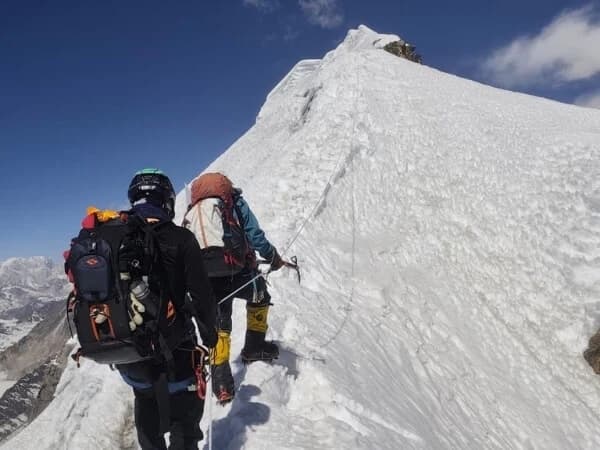
From High Camp, it becomes proper climbing. You move on snow slopes, then onto fixed ropes, especially on the steeper headwall section before the ridge. After that ridge, it’s just the final walk to the summit. Coming down is the same way, no different route, just retracing everything step by step back to base camp.

Altitude sickness and acclimatization tips for Lobuche Peak

Lobuche Peak is around 6,090 meters, so altitude is just part of the whole experience, not only the climbing part. You start noticing it on the way up itself during a Lobuche Peak climbing expedition in Nepal, not suddenly at the top.

Once you cross around 3000 meters, things already feel a bit off compared to normal. You walk slower without meaning to, and even small climbs take more effort. That is just how it is up there.

A lot of people mess up by trying to keep a strong pace. It feels fine at first, then it hits later. Going slow is not just advice, it actually makes the whole climb easier in the long run.

Taking an extra night in places like Namche Bazaar or Dingboche really helps, even if it feels unnecessary at the time. That small pause makes a difference once you go higher in mountaineering in Nepal.

Water is another thing people forget. You don’t feel like drinking much, but if you don’t, you start feeling off and can’t really tell why.

And yeah, you have to be honest with how you feel. Headache, slight dizziness, not feeling like eating, those are early signs. Ignoring them is where people usually get into trouble.

Up on Lobuche Peak, you can’t really push through altitude. If your body slows down, you go with it. That’s pretty much it.

Gear and Equipment Recommendations for Lobuche Peak Climbing

For Lobuche Peak, gear only starts to matter when you actually get higher. Down on the trail, almost anything feels fine, but once you are near High Camp, you notice pretty quickly what is working and what is not.

Boots are the big one. If they don’t fit well or feel solid with crampons, the climb just turns annoying fast. Good Lobuche Peak climbing gear really just means your basics are reliable, not fancy.

On the climbing section, you will be using crampons, an ice axe, and you will be clipped onto ropes for a part of the route. So a harness, helmet, and something like a jumar is normal to have during a Lobuche Peak climbing expedition in Nepal. It is not a huge amount of gear, but you do need to know how to use it properly.

Clothing is just about staying warm enough to keep moving. A proper jacket, decent gloves, and layers that you can adjust easily make more difference than people expect when it comes to mountaineering in Nepal.

And then there are small things that don’t seem important until they are. A headlamp for the early start, sunglasses when the sun hits the snow, and a bag that is not a pain to carry.

Most people don’t show up with everything. Renting Lobuche Peak climbing gear in Nepal is pretty normal, especially for the technical stuff.

Guide and Porter Support for lobuche Peak Base Camp Climbing 

On Lobuche Peak, once you leave base camp, you are basically on your own in a cold, steep environment where the route turns into snow slopes and rope sections. That is where guides for Lobuche Peak climbing actually come in and make sense, because they know the line, handle the rope work, and keep you moving without getting stuck or lost in the upper part.

Porters don’t go up for the climb. They help on the way in, carrying the bigger bags so you are not worn out before reaching base camp. Most people don’t realize how much that helps until they try carrying everything themselves.

That’s all it is. One person helps you climb, the other helps you get there with some energy left.

Food, Accommodation, and Water at Lobuche Peak Climbing

On Lobuche Peak, it is pretty basic the whole way once you are up in the higher part of the valley during a Lobuche Peak climbing expedition in Nepal.

Food is the same kind of thing everywhere. Dal bhat, noodles, eggs, soup. In the lower villages you might still look at a menu, but honestly most people just end up eating whatever is quick and filling. Higher up near Lobuche, you don’t even think about variety anymore, you just eat and move on.

Accommodation is simple. Teahouses on the way are small rooms, usually just beds and blankets, and that is it. Nights get cold, and you can hear everything through the walls. Once you are at base camp, it is tents, no proper building, just sleeping bags and trying to rest before the climb.

Water is something you don’t take for granted. In villages it is boiled or filtered, but higher up it is carried in or melted from snow. You drink what is there and try not to run low, because there is no easy backup option in mountaineering in Nepal at that altitude.

Do I need travel insurance for Lobuche Peak climbing?

Yes, you really should have travel insurance for Lobuche Peak. Not the normal kind for delayed flights or lost bags. You need proper cover for a Lobuche Peak climbing expedition in Nepal.

Once you are above 6,000 meters (about 6,090 m), things are not handled casually. If something goes wrong up there, you are not just walking it off and heading back slowly. Most of the time it turns into a helicopter evacuation, and that is not cheap at all.

So the insurance has to clearly include high altitude climbing and emergency evacuation. If it doesn’t say that, it is basically useless for this kind of trip.

Alternatives of the Lobuche Peak Climbing Base Camp Service 

For Lobuche Peak, people usually compare a few other peaks before deciding on a Lobuche Peak climbing expedition in Nepal, because it sits somewhere in the middle in terms of difficulty.

A lot of climbers also look at Island Peak Climbing. It’s quite similar in terms of style, but the glacier section involves more rope and gear use, so it feels a bit more technical., so people often hear about it as a “next step” after trekking.

Then there is Mera Peak. That one is more about going higher rather than dealing with technical climbing. The route is longer, but you don’t get as much rope work compared to Lobuche, so it attracts people who want a big altitude experience in mountaineering in Nepal.

If someone wants something simpler and shorter, Yala Peak Climbing often comes up. It is more basic, usually used as an introduction to peak climbing without the same level of technical sections.

So in real terms, Lobuche feels like the middle ground. Island Peak has a bit more technical feel, Mera Peak is about altitude, and Yala Peak is more like a first step into climbing.

FAQs

Lobuche Peak is not an easy trek, but it is also not a full on technical expedition all the way. The walk to base camp is normal trekking, but above that it turns into snow climbing with ropes. Most people struggle more with the altitude than the actual climbing during a Lobuche Peak climbing expedition in Nepal.

No, but let’s be honest, it helps. If you have never used crampons or walked on snow slopes before, it will feel new and a bit awkward at first. Guides will show you everything, but you still need basic fitness and the mindset to keep going when it gets uncomfortable in mountaineering in Nepal.

Usually around 16 to 18 days. Some people try to shorten it, but that often makes acclimatization worse. The summit itself is one push, but the approach takes most of the time.

The summit is about 6,090 meters. Simple truth is you will feel the altitude long before you reach that point, even while trekking in the lower valleys.

Yes, and it is not rare. People who ignore early symptoms or try to rush usually end up slowing down or stopping. There is no shortcut here, your body decides the pace, not the itinerary.

Basic and repetitive. Teahouses are simple rooms with shared bathrooms. Near base camp it becomes tents, so no comfort at all. Food is mostly the same dishes every day, and you eat it because you need energy, not because you have options.

If you are asking this seriously, then yes, you do. Above base camp there are ropes, steep snow, and exposure. It is not a place to “figure it out”. Most accidents in Lobuche Peak climbing expedition in Nepal happen when people underestimate that section.

Lobuche Peak is sometimes marketed as beginner friendly, but that is a bit misleading. It is fine for fit beginners, but only if they accept cold, altitude, and basic snow climbing. If you expect comfort or easy hiking, this will feel hard during a Lobuche Peak climbing expedition in Nepal.

It gets cold enough that people underestimate it every season. At High Camp and above, temperatures can drop far below freezing, especially at night. Wind makes it worse. If your gear is not right, you will feel it quickly.

It happens more often than people admit. You turn back. That is it. Weather, altitude, or fatigue can stop a summit attempt, and that is normal in mountaineering in Nepal. The mountain is not going anywhere, but your safety always comes first.

20 years of Adventure
Why Travel with Nepal Trekking Routes?
We Care for Your Safety
Nepal Trekking Routes always focus on safety, and satisfaction of our valued clients. Our Trekking guides are highly experienced and trained to operate various group trekking trip in high Himalaya.
Provide Financial Protection
NTR prioritize healthy financial safety for clients, ensuring proactive safeguarding of client interest. Our commitment strengthens our role as trusted partners maintaining standards with dedication and Excellence.
100% Local Guide
100% Local Guide
Traveler looking for experience authentic insights through trekking in Nepal NTE offer your 100% local guide who help you to experience unique perspective ensuring and enriched journey customize to your interest.
Personalized Service
We always provide one guide and one porter to two guests in order to meet our standard of providing standard service. Impeccable hospitality and quality services are guaranteed while traveling with us.
Know More
Book Now