If you are looking for traditional villages in Nepal, don’t expect everything to feel untouched or frozen in time. Some places are already shaped by tourism, some are still proper working villages where people farm, raise animals, and just go about daily life without thinking about visitors.
Bandipur, Ghandruk, Sirubari, and Ghalegaun are the names that come up most. They are not hidden anymore, but they are still some of the easiest places to see rural Nepal without going deep into remote areas where travel gets complicated. In a few of these villages you are literally staying inside local homes, eating what the family eats, and living the same routine for a day or two. In others, it is more structured and focused on visitors.
This blog will show you a few traditional villages in Nepal that are actually worth your time, depending on what you want to see. Some are better for homestay experiences, some for culture, and some just for getting a real feel of the countryside without overthinking it. If you are planning to explore rural Nepal villages, this should help you pick a place that fits your trip instead of just going by names you keep seeing online.
What Traditional Villages in Nepal Are Really Like?
Villages in Nepal are not all the same, and most of them are not untouched like people often assume from travel photos. What you actually find depends on where you go, how remote it is, and how much tourism has reached that area.
Some rural communities are still mainly farming based. Life there revolves around agriculture, livestock, and seasonal work. It is normal daily routine living, not something shaped for visitors. You will still see terraced fields, stone houses, and old working patterns, but even in these places, younger people often leave for jobs in cities or abroad, so the structure of village life is slowly changing.
In other areas, especially along popular trekking routes and accessible hills, community tourism has become part of everyday life. These places are where homestay experiences are common. Local culture is still visible, but guest houses, lodges, and trekking visitors are now built into the system. It feels like real village life, just adjusted to constant visitors.
Then there are hill towns and heritage places that people also group into the same category. They keep older architecture and cultural identity, but they are more developed, with better roads, shops, and services compared to remote rural communities.
Then there are hill towns and places people still call villages even though they are a bit more developed now. They keep older architecture and cultural identity, but they also have better roads, shops, and services compared to the actual rural villages. So the feel is different, more mixed, less raw.
So when people search for rural experiences and homestay villages in Nepal, they are mixing all of this together. What you get really depends on the place and, sometimes even the part of the same village you are in.
Best Traditional Villages in Nepal to Visit For Real Rural Life and Homestays
Some of these places are still regular farming villages, others already run homestays where visitors are part of daily life. The experience changes a lot depending on which one you end up in. The villages are categorized in groups so that it’s easier for you to actually know what kind of experience you are getting on.
Remote Farming Villages in Nepal (Low Tourism Influence)
Take a look at these remote farming villages in Nepal:
Sikles Village (Kaski)
Sikles is in Madi Rural Municipality of Kaski, northeast of Pokhara. You reach it by road from Pokhara through the Pokhara Baglung Highway side and then turning towards the Sikles road section near the Madi valley.
It is still a working Gurung village in the Annapurna region. Most households are still involved in farming along with other local work. You will see normal daily routines happening in the fields and around the village, with tourism present but not dominant. It is not a place that depends fully on visitors, so the flow of life feels more local than commercial. Compared to more popular trekking villages, it has a slower, more grounded feel.
Ghachok (Kaski District, Gandaki Province)
Ghachok lies in Machhapuchhre Rural Municipality, a bit northwest of Pokhara. You go out of Pokhara toward the Annapurna foothills and then turn into the local road network that leads into the village side.
It is still mostly a farming village. People grow what they need, keep livestock, and do local work around the area. You see fields and irrigation channels around the houses, and daily life is tied to seasons more than anything else.
There are a couple of homestays, but they are not really what the place runs on. Most of the village has nothing to do with tourism. It has not been shaped by trekking routes or visitor traffic, so it still feels like a regular village rather than a travel stop.
Khaptad Region Villages (Doti, Bajhang, Bajura districts, Far Western Nepal)
Khaptad National Park covers parts of Doti, Bajhang and Bajura in Far Western Nepal. The villages linked to this area are reached from Dhangadhi or Dadeldhura, then continuing by road into the hills. From there, travel mostly continues on foot depending on which village or entry route is being used for Khaptad.
Around Doti, places near Silgadhi and small villages like Jhingrana are part of the usual entry side. In Bajhang, Chainpur and nearby areas under Jaya Prithvi Municipality are what connect toward the park direction. On the Bajura side, Martadi and surrounding hill villages are part of the same broader access zone.
Life in these villages is still based on farming and people grow crops depending on the season and keep livestock. Houses are not clustered tightly, they are spread out across slopes and fields. You don’t really see anything shaped around tourism here. Daily routine is more about land and weather than outside visitors.
Not many people go there just for villages. Most outsiders are actually heading toward Khaptad itself. You don’t find homestay networks or anything built around tourism in most of these places. It is not part of the usual trekking circuit either, so visitor flow is low.
If someone is looking for traditional villages in Nepal in the sense of everyday rural life without tourism influence, this region fits that idea more than most popular village destinations. But it is also not set up as a travel experience. It is just normal Far Western rural life.
Community Homestay Villages in Nepal (Locally Run Rural Experience)
Here are some community based homestay villages in Nepal which are run by the locals:
Sirubari (Syangja District, Gandaki Province)
Sirubari is in Arjun Chaupari Rural Municipality in Syangja, west of Pokhara. You reach it from Pokhara through Waling and then a road that continues into the hills until the village area. It is not on any trekking route, so nobody ends up there by chance while going somewhere else.
Sirubari is known because it was one of the first villages in Nepal to run a proper community homestay system. The village decided to host visitors in local homes instead of building hotels. That decision is what made it well known in Nepal’s rural tourism.
People who visit are mostly travelers coming for a short rural stay. Everything is arranged before arrival, including where you stay and meals with the host family. They even welcome you with flower garlands and Panchai Baja music. You stay with a family and take part in daily routines, but there is no independent exploring style like in trekking villages.
People continue normal village work and farming, but tourism has become part of how the village operates. It is better understood as a homestay village than a place that shows untouched rural life.
Ghalegaun (Lamjung District, Gandaki Province)
Ghalegaun is in Lamjung, above Besisahar side, reached by road that continues into the Gurung villages facing the Annapurna and Manaslu ranges. It is not part of the Annapurna Circuit trekking route, but it still gets visitors because of homestays and the mountain views.
Before homestays became common, it was just another Gurung village in the hills doing normal local work like nearby villages. That still exists, but things changed once homestays started spreading across households.
Gurung culture in Ghalegaun is visible in daily life. People greet guests directly and usually offer food soon after they arrive. Visitors stay in local homes under the community homestay system, where different families take turns hosting.
In the evenings, people sit around, talk, sometimes include visitors in songs or local moments, and it just happens because visitors are part of the normal flow now.
Life here is still very much local, but tourism is already woven into it instead of sitting outside it.
Popular Traditional Villages in Nepal (Cultural and Tourist Villages)
Here are some of the popular villages in Nepal which you have probably heard about:
Ghandruk Village
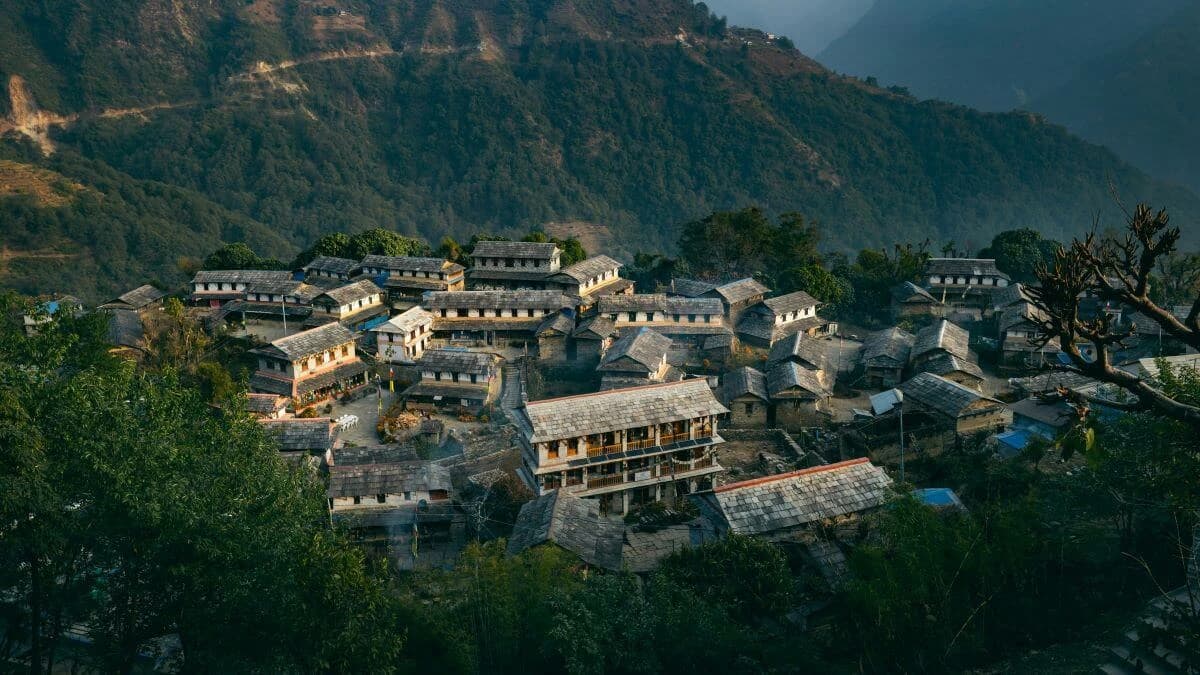
Ghandruk village is one of the most visited villages in the Annapurna region and it is heavily used in ABC trekking routes. It receives a constant flow of domestic and international tourists throughout most of the year, especially during trekking seasons. Because of this, tourism is not something separate here anymore, it is part of daily life in the village.
Most houses in the main area are used as homestays or small lodges now. Farming is not the main source of income for many families anymore. You will notice that the daily routine here moves around the tourists just as much as it moves around local life.
One thing people usually miss is the Gurung museum inside the village. It is small and not heavily advertised, but it shows old clothing, tools, and everyday objects that were used before trekking tourism became normal here. It gives a better idea of how much things have changed.
Bandipur (Tanahun District)
Bandipur is probably one of the hardest places in Nepal to describe properly. People call it a village, but it does not really feel like the kind of rural village most people picture. At the same time, it does not feel like a typical town either.
What makes Bandipur interesting is that it has managed to keep a lot of its older character without feeling like a place that exists only for tourists. When you walk through the main bazaar area, you notice rows of old Newari houses, traditional windows, and brick buildings that have been around for generations. The fact that vehicles stay out of the main street also changes the atmosphere quite a bit.
A lot of articles focus on the mountain views, but honestly, that is not what makes Bandipur memorable. There are plenty of places in Nepal with mountain views. What people tend to remember is the feeling of walking through a place that still looks connected to its past.
Bandipur was once an important stop for traders moving goods through the hills. When newer highways changed travel routes, the town lost some of that importance and many people moved elsewhere. In a way, that is part of the reason so much of the older architecture survived.
I would not put Bandipur in the same category as places where you go specifically to experience rural life or stay with farming families. It is better for people who are interested in culture, local history, and older parts of Nepal that have not completely disappeared under newer development.
That is also why Bandipur keeps showing up on lists of traditional villages in Nepal as it has managed to hold on to a character that many places have already lost.
Bungamati and Khokana (Lalitpur District)
Bungamati and Khokana are mentioned together because they are close to each other, but they leave quite different impressions.
Bungamati is known for its link to Rato Machhindranath and the long wood carving tradition connected with Newari culture.
Carved wooden windows and old details are still easy to notice in many parts of the village. A few workshops are still active, even if the work is not as widespread as it used to be.
Khokana is known for mustard oil production using traditional methods. It was once a major source of locally made oil in the Kathmandu Valley, and that history is still part of how people describe the village today, even though the production has reduced.
Both places are often included in lists of traditional villages near Kathmandu because of how close they are to the city. That closeness is obvious, but once inside the older lanes, the setting feels quite different from the surrounding urban areas.
Neither Bungamati nor Khokana works as a trekking stop or a homestay tourism hub like some rural villages in Nepal. Visits here are usually short and focused on Newari culture, older architecture, local traditions, and the way daily life continues inside these older communities.
For anyone searching for traditional villages near Kathmandu or places connected to Newari heritage in Nepal, these two remain among the most accessible options. They are not untouched, but they still hold parts of a way of life that has slowly reduced in many other areas around the valley.
Marpha (Mustang District)
Marpha is in Lower Mustang, and it already feels different from most places people usually mean when they say traditional villages in Nepal. The land itself changes first. It becomes dry, wide, and open, and the village lies in that kind of landscape rather than green hills or forest areas.
The houses are mostly whitewashed stone buildings with tight rows along narrow lanes. The layout feels controlled and structured, not scattered or random like many rural villages in Nepal. It reflects the way villages in Mustang were built for wind, cold, and limited resources.
Apples are a major part of life here as almost every household has some connection to apple farming or apple products like dried slices, juice, or apple brandy. This is not only for visitors. It is part of the local economy and one of the main reasons Marpha is known across Nepal.
Even though many people pass through on the Jomsom Muktinath trek route, the village itself does not feel crowded. There is movement, but it does not disturb daily life or change the way things run.
A monastery named Marpha Gompa is also part of the village, along with small religious structures placed around different corners. Prayer flags and stone walls are common, and they blend into the village instead of standing out as separate attractions.
Marpha is included in the list of places to visit in Mustang, but it is not the same as the green hill villages most people imagine.
How to Choose the Right Village in Nepal?
If I was planning this myself, I would not try to rank villages in Nepal or chase the most mentioned names. I would try to avoid a mismatch, because most disappointment comes from expecting one type of place and ending up in another.
For example, I would not pick Sirubari or Ghalegaun if my expectation was quiet rural life in Nepal. These places already have a fixed way of receiving guests. That is the point of community homestay villages in Nepal. You are not drifting through normal villages, you are entering a system that is prepared for visitors in advance. If someone expects raw daily life, this will feel too arranged.
On the other hand, I would not choose Sikles or Khaptad side villages if what I actually wanted was interaction and guided experience. Those places do not help you experience anything. Life continues normally and you are just present in it. That can feel empty or confusing if someone is expecting storytelling, demonstrations, or structured cultural exposure.
If architecture and local history matter more to me than rural life itself, I would probably lean toward Bandipur, Bungamati, or Khokana. A lot of lists group them among the best heritage villages in Nepal, and that is largely because of how much of their original character is still visible. You notice it in the old Newari houses, the narrow streets, and the way everyday life still unfolds around spaces that have existed for generations.
They are not the places I would choose to understand farming communities, but they are some of the most interesting cultural villages in Nepal if you enjoy history and traditional architecture.
Ghandruk is the one that creates the biggest gap between expectation and reality. It is often sold as a traditional Gurung village in Nepal, but the lived reality is heavily shaped by tourism now. That does not make it less valid, it just means the village experience there is already filtered through lodges, guides, and constant visitor flow. Make sure to decide what type of experience you want before you plan anything around it.
And if you are tired of seeing the villages with similar kinds of landscape, Marpha is the place I would choose if I wanted something that feels completely different from the hill villages most people picture when they think about rural Nepal. The landscape changes, the architecture changes, and even the atmosphere feels different. Known for its Thakali culture and apple orchards, Marpha is considered one of the most distinctive traditional villages in Nepal, especially for travelers already heading toward Mustang.
It all depends on what kind of experience you are drawn to. A particular village cannot meet all of your expectations at once.
What Traditional Village in Nepal Actually Means Today
The term traditional villages in Nepal is used for very different kinds of places, even though they don’t offer the same kind of experience.
Some rural villages in Nepal are still farming based. People live off agriculture and livestock, and tourism is not the main part of daily life.
Some villages run on community based tourism in Nepal, where homestays are part of how families earn money and visitors are expected.
Some places are better described as heritage villages in Nepal, where old buildings and culture are the main reason people visit, not village work.
Because all of these fall under the same label, the experience depends entirely on the place, even if the name sounds similar.
Final Verdict: Traditional Villages in Nepal
There isn’t one version of a traditional village in Nepal. The same label gets used for places that don’t feel anything alike once you’re there.
Some are still farming villages, some work as homestay destinations, and some are closer to old cultural towns than rural life. They are not meant to offer the same experience. What you get depends on the place you choose, not the category it is placed under.