Transportation in Nepal might not sound like a big deal until you are actually outside Tribhuvan International Airport trying to figure out why the taxi prices are all different for the same exact ride. That’s when getting around Nepal stops being a fun thought and becomes something you are actively trying to figure out.
Nepal buses, taxis, and domestic travel are all part of daily life here, especially in Kathmandu, but the way they operate can feel inconsistent if you are seeing it for the first time.
After that, you just start dealing with things as they come. One minute you are jumping into a microbus because it is already leaving, next minute you are bargaining with a taxi driver because there is no meter anyone trusts. In Kathmandu, this is normal.
Between cities it is the same feeling. Buses leave when they are ready, not always when the schedule says. Some are fine, some are basic, and you usually only find out after you are already on them. Flights are an option for longer routes, but delays are common enough that people do not build tight plans around them. Once you accept that things get easier to deal with.
Taxis in Nepal: The First Thing Most Travelers Deal With
For most visitors, taxis are their first introduction to transport in Nepal, and usually their first lesson that things do not always work the way they expected.
Taxis in Nepal have meters installed, but a lot of rides do not actually end up running on them. What you hear first is a quoted fare. That number depends on the driver, the location, and how busy things are at the time. Two taxis parked next to each other can give different prices for the same destination.
Kathmandu traffic makes things worse in its own way. A short distance can turn into a longer ride without any real warning. You only notice it once you are already stuck in it.
Most people just ask the price first and decide from there.
Ride Apps in Kathmandu, Nepal
Apps like Pathao, inDrive, Yango, and Uber are now part of daily transport in Kathmandu. Most people start using them after a few taxi rides because street pricing can feel inconsistent and there is no clear standard you can rely on as a visitor.
Pathao is the most visible in the city, mostly because of the number of bikes on the road. inDrive works differently unlike other apps, as you can set the price and wait for a driver to accept it. Yango shows the fare before you confirm the ride. Uber is newly launched in Nepal and it does not appear as often in every part of the city compared to the others.
These apps are far more common in the capital than in other cities in Nepal. Once you leave Kathmandu, options become more limited and in some places you may not find active drivers at all.
Most of what you see on these apps in the city are bikes, since they move through traffic more easily. Cars are there too, but not as often, especially when the roads are busy.
In different parts of Kathmandu, the experience changes a bit. Central areas naturally have more drivers available, while outside those areas it can take longer to get a ride. Prices also fluctuate depending on demand during the day.
Local Buses and Microbuses in Nepal
Local buses and microbuses run all over Nepal and you notice them quickly once you start moving around. They are on city roads, between towns, and on the main highways where people are traveling long distances without spending much.
They do have fixed stops, but in practice one of the most common ways people use them is by simply signaling from the roadside and getting on when the bus slows down. The same thing happens when getting off, people just tell the conductor or signal when they need to stop.
They are cheap, which is why they are almost always full. In cities like Kathmandu and Pokhara, microbuses keep stopping along the route to pick up and drop off passengers. It is frequent, and there is usually very little space between stops during busy hours.
For longer distance travel, larger buses operate between cities like Kathmandu to Pokhara and Kathmandu to Chitwan. Local buses on these routes often wait until they have enough passengers before leaving. Tourist buses on the same routes are more likely to leave at a set departure time, but conditions on the road still affect timing.
Route information is written in Nepali, so it is helpful for the first time travelers to ask people at the stop or check with the conductor before getting on.
Tourist Bus Travel in Nepal (Kathmandu to Pokhara and beyond)
Tourist buses in Nepal mainly operate on the popular intercity routes like Kathmandu to Pokhara and Kathmandu to Chitwan. These are the routes most people come across when searching for Nepal bus travel or Kathmandu to Pokhara bus options.
From Kathmandu they leave from bus parks or set pickup points depending on the company. You do not really just catch them anywhere on the road like local buses. Most people book through hotels, travel agencies, or directly with the operator before the day of travel.
Seats are assigned, so at least that part is clear once you are on board.
The travel time depends heavily on road conditions, traffic, and weather, especially on the Kathmandu to Pokhara route where delays can happen depending on the day.
Travel time depends on road conditions, traffic, and weather. On routes like Kathmandu to Pokhara, the same journey can take different amounts of time depending on what is happening on the road that day.
Some buses feel newer and have more space, while others are more basic, and what you get depends on the company you book with rather than a single standard across all operators.
Most long distance trips include one or two stops for food and rest. These stops are part of the journey and happen along the way.
Tourist buses are more organized than local buses and cheaper than flying, but the experience still depends heavily on road conditions in Nepal.
Domestic Flights in Nepal
Nepal is a country where a journey that takes 30 to 90 minutes by air can easily take several hours by road, so flights become tempting very quickly.
Most domesticflights in Nepal leave from Kathmandu, and if you are flying domestically after arriving in the country, just know that the domestic terminal is separate from the international terminal at Tribhuvan International Airport.
The main domestic flights in Nepal operate from Kathmandu to places like Pokhara, Bharatpur, Nepalgunj, Biratnagar, and then further out to mountain region flights such as Lukla for Everest Region Trekking. These routes are handled mainly by airlines like Buddha Air, Yeti Airlines, and Shree Airlines, and they all operate in a similar way without much difference in service level.
One thing you must be really aware of is how much weather controls the flight schedules in Nepal. Our country lies in a very mountainous zone and that affects visibility more than what anyone can expect. Early morning flights have the highest chance of departing on time because the weather is clearer at that hour. As the day moves forward, especially during monsoon months or winter haze in Kathmandu, delays start happening more. There are some incidents where the passengers had to wait for hours because of the delay.
Prices change depending on season and demand. During busy trekking months, routes like Kathmandu to Pokhara get more expensive and seats can fill up faster than people expect.
Most people take domestic flights in Nepal mainly to save time. It is the fastest way to cover long routes, but delays due to weather are still part of the experience.
How To Avoid Over Paying For Transport in Nepal
It’s normal for tourists to get confused about the prices of the vehicles, especially when they are in a new country and this is the reason why most people end up overpaying the fare.
First confusion starts from taxis quoting different fares for the same destination when you first land in Nepal. The first number you hear is higher than what locals actually pay. Checking a second driver or walking a short distance outside the pickup area gives a better Kathmandu airport taxi price.
Ride apps like Pathao, inDrive, and Yango are widely used in Kathmandu for city travel. They show fares before the ride, which makes pricing clearer compared to street taxis. Many travellers still take street taxis without checking the apps, which is where extra cost happens on short distances. So if you are on a budget friendly tour in Nepal, make sure to download these apps to clearly understand the current transport fare trend.
If you are traveling on a bus, routes like Kathmandu to Pokhara and Kathmandu to Chitwan have both tourist buses and local options. Booking through hotels or agents adds a small commission in many cases. Direct booking at bus counters or with operators matches the standard Nepal transport cost for those routes.
In trekking regions, private jeeps are hired as a whole vehicle rather than sold by individual seats. This is common on routes around Jomsom, Upper Mustang, and parts of the Langtang region. Travellers who are not aware of this sometimes pay the full jeep fare when there are opportunities to share the cost with others heading in the same direction.
Domestic flights also become more expensive during the busiest travel periods, particularly in spring and autumn when trekking numbers are highest. Popular routes can fill up quickly and last minute booking leaves fewer flight options available.
Most transport overpayment in Nepal happens when travellers confirm the first option without checking one alternative for the same route, which is enough to avoid unnecessary extra cost. So make sure you look for alternatives before finalizing the very first option that you see.
How To Choose The Right Transport in Nepal (Based on distance and situation)
Choosing transport in Nepal becomes easier once you start thinking based on what situation you are actually in at that moment.
Inside Kathmandu, if you are with a group, a car through ride apps like Pathao or inDrive usually makes more sense than trying to manage separate bikes or multiple taxis. It keeps everyone in one vehicle and you see the price before you confirm, which helps in a city where street taxi fares are not always consistent.
If you are alone and moving around the city, bikes through ride sharing apps are your life savers. They move through traffic faster, especially during busy hours, and for short distances it saves both time and effort compared to waiting for a car or negotiating with taxis.
If you are doing the intercity travel with limited luggage and you are not in a rush, tourist buses are the most common choice. They are easier to manage because you just book a seat and it’s all sorted. If timing matters more to you, or you want to cut down the travel hours, you can take a flight, but only if you are okay with the possibility of delays depending on weather.
If you are carrying more luggage or traveling with family, private cars or taxis become more practical inside cities and for short intercity transfers because you don’t have to deal with stops or coordination with other passengers. Remind you, the cost is higher, but people choose it for convenience and to avoid the hassle of handling your belongings.
Similarly, if you are heading towards places outside the main road network, shared jeeps are what you’ll use because regular transport options are limited.
Nepal Transport Cost 2026 (real prices explained)
After the fuel price increase in Nepal, transport cost went up across everything. There is no fixed system you can fully depend on except public buses. Everything else changes depending on demand, time, and how you handle it.
Public buses are the only proper fixed price option. You pay according to the route and that is it. That is why Nepal's public transport system still survives even though they are crowded and uncomfortable.
Inside Kathmandu, taxi fares for normal city travel are usually around NPR 300 to 800. Longer routes, traffic, or waiting time can extend it to NPR 1000 to 2000.
Bike rides inside Kathmandu are usually around NPR 150 to 400 depending on distance and demand. Car rides for short city routes are around NPR 300 to 900. Rain, peak hours, or low driver availability increase prices without any warning, which is just how Nepal ride sharing apps function in real conditions.
Local buses and microbuses are still the cheapest way to get around Nepal. In Kathmandu, short rides start at around NPR 25, while fares in other cities depend on how far you are going. The price is fixed, so you do not have to negotiate with anyone. Get ready for how crowded the buses can get. During school hours, office hours, and evenings, finding a seat is not always possible. Sometimes the bus is already full and people are still getting on. If you just want the cheapest way to travel, buses do the job. Just do not expect much space or comfort.
For long distance travel, public buses between cities usually cost around NPR 800 to 1500 for routes like Kathmandu to Pokhara or Kathmandu to Chitwan. They are slow, stop often, and timing is not strict. Tourist buses on the other hand, cost around NPR 1500 to 3000 depending on comfort and operator.
Flights inside Nepal operate from Kathmandu to places like Pokhara, Biratnagar, Nepalgunj, Bhairahawa, Janakpur, and a few other regional airports. Trekking flights like Lukla are different because prices change a lot during peak season. Most routes cost around USD 100 to 115, while Lukla and other remote flights can go around USD 215 to USD 255 (one way) for foreign nationals.
Private jeeps are used all over Nepal, not just on the popular tourist routes. They run to places like Kathmandu to Pokhara, Kathmandu to Jomsom, Syabrubesi for Langtang, and further out to Salleri and Phaplu for Everest region access.
If a full jeep is hired for the whole trip, not per person, and it costs around NPR 12,000 to 30,000 depending on how far the route is, fuel price at the time, and road condition. It only really makes sense when a group shares it, otherwise it gets very expensive.
Kathmandu Transport Guide for Tourists
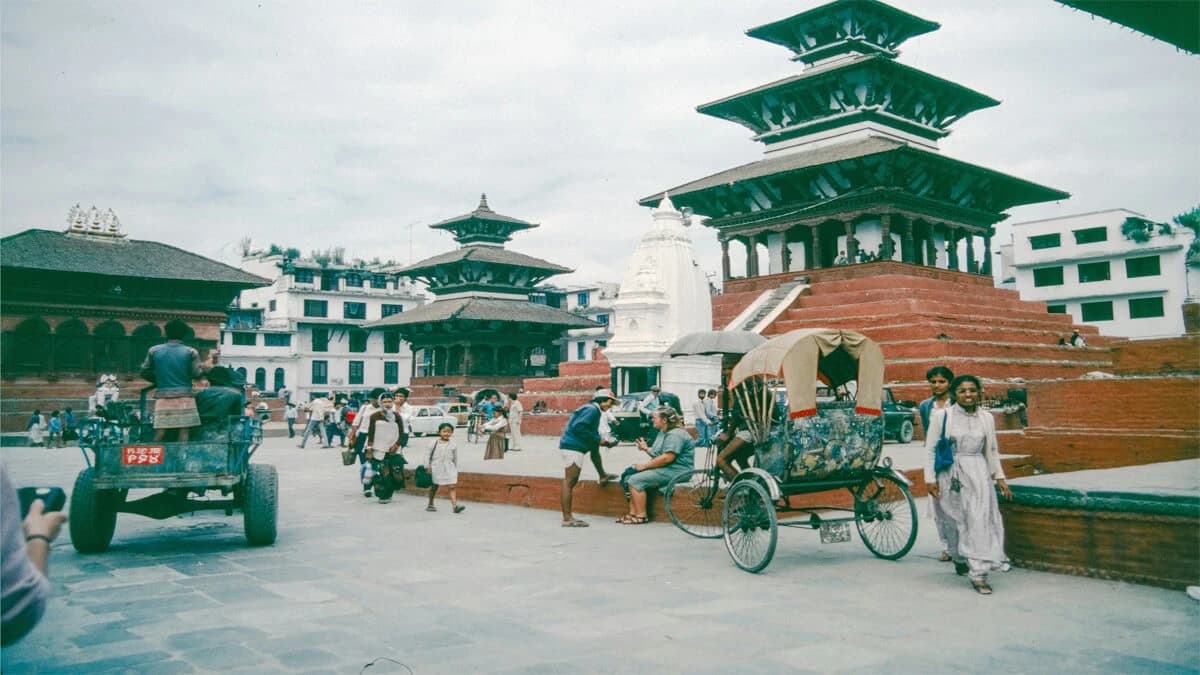
Walking is a big part of moving around Kathmandu. In places like Thamel, Asan, Durbar Marg, and nearby streets, everything is close. While looking online it looks like a short ride, but traffic makes it slower than how you’d expect.
Most people just walk instead. Shops, hotels, cafes, and small markets are all packed into the same areas, so there is no real need to take a ride for short distances.
Vehicles are used when the distance is longer or when someone is carrying bags. For small trips, walking makes more sense because waiting in traffic takes longer. This is what looks normal in central Kathmandu and is the simplest way to move around.
Is Transportation Safe in Nepal?
Yes, it is generally safe. Most people don’t face safety issues while using buses, taxis, ride apps, or flights. The main thing is the system itself feels unorganized compared to what many travelers are used to. Traffic is heavy in cities, buses can get crowded, and the time you are given is always not reliable. Flights are also safe but can get delayed because of the weather.
Is Uber Available in Nepal?
Uber works in Nepal, but you won’t see it as much in Kathmandu compared to other ride apps. Most people use Pathao, Yango, or inDrive instead because there are more drivers and faster pickup. Uber is around, just not the main option people rely on for daily travel.
To Wrap Up
Nepal transport doesn’t really feel organized until you are actually moving around in it. One trip can be a walk, the next one a bike ride through traffic, and longer distances turn into buses, flights, or jeeps depending on what’s available. That’s how Nepal transport works in 2026.


.webp&w=1200&q=75&dpl=dpl_4U3CaZUV3Y5iKdBNPJmVMATJy3AB)