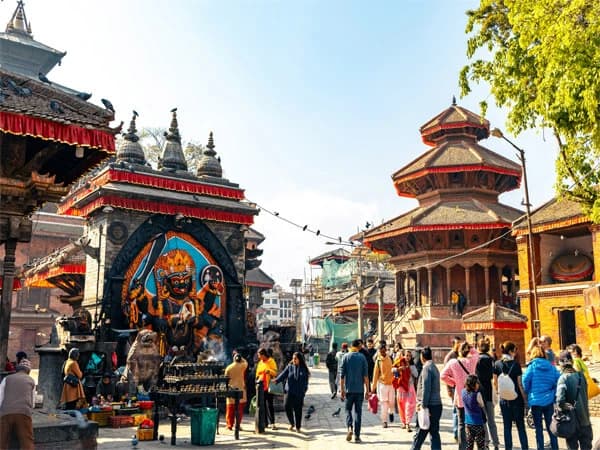
Did you know Nepal has its own living goddess, that too in 2026? Right in the middle of Kathmandu, a young girl is chosen as the Kumari and worshipped as the living embodiment of Goddess Taleju. She lives inside the Kumari Ghar near Kathmandu Durbar Square, a place most people walk past without realizing what actually happens behind those carved wooden windows.
The living goddess of Kathmandu is mainly seen during religious ceremonies and major festivals where huge crowds gather for her blessings.
For many people visiting Nepal, the tradition feels difficult to believe at first and the first time you hear about it, it honestly sounds like something from an old story rather than a living tradition. But in Kathmandu, it is still part of everyday culture life, especially within the Newar community.
At the same time, it is not a simple tradition to explain. Some people treat it with deep devotion, others question it more openly, especially when they think about what it means for a child to grow up in that role. And that tension is exactly what makes the Kumari tradition so widely talked about.
In this guide, we will go through where it came from, how Kumari is chosen, what life inside the Kumari Ghar is actually like, and why this practice still exists in modern Nepal. And if you are looking for things to do in Kathmandu, visiting the Kumari house is definitely worth it.
Who is the Kumari? Meaning of Nepal’s Living Goddess
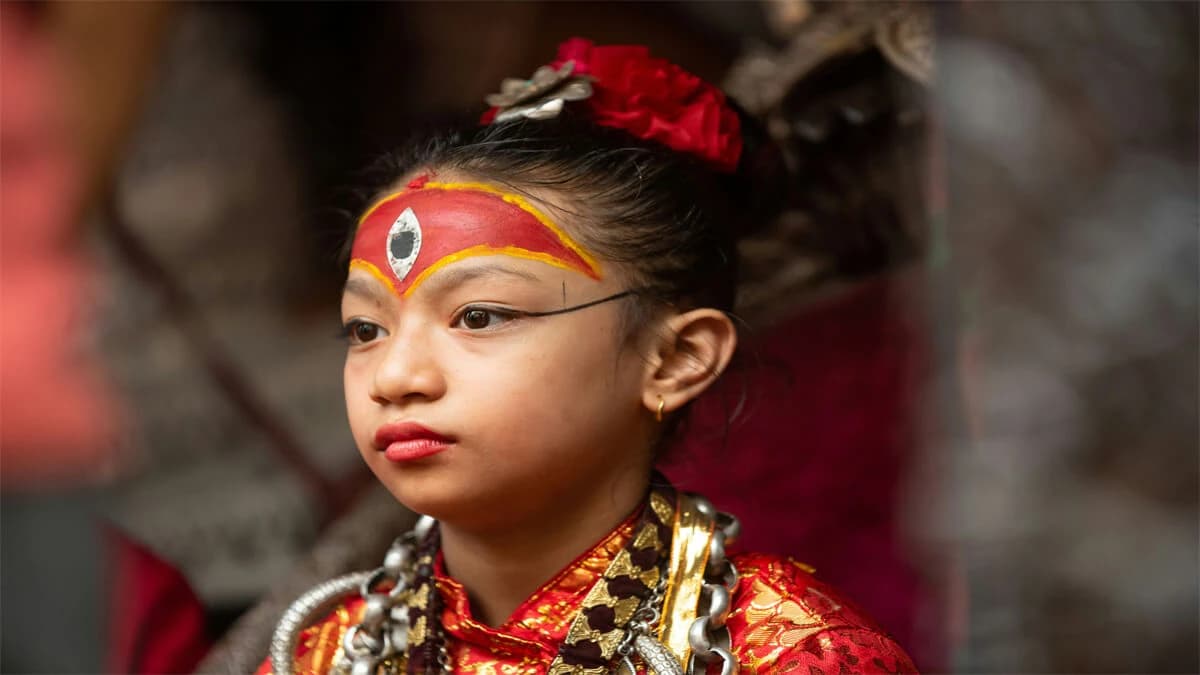
In Kathmandu, the Kumari is a young girl (between 2 and 5 years old) chosen from specific Newar Buddhist families, mostly from the Shakya Community, and she is worshipped during her time as the incarnation of Goddess Taleju (a form of goddess Durga). The word Kumari means virgin in Sanskrit, and in this tradition it refers to a pre pubescent girl selected through a strict religious process that has been followed for generations. For people who believe in it, this isn’t symbolic at all. They see her as the goddess present in human form for that period.
That belief itself comes from a long mix of Hindu and Buddhist traditions in the Kathmandu Valley. Goddess Taleju is considered a powerful protective deity, and the Kumari is regarded as her earthly manifestation during her tenure. That is why during festivals and rituals, especially around Kathmandu Durbar Square (one of the UNESCO World Heritage sites in Nepal), she is shown deep respect and people come forward to receive blessings. It’s very structured and tied to specific ceremonies, not something that happens casually everyday.
The most known is the Royal Kumari of Kathmandu, who lives in the Kumari Ghar near Durbar Square and appears during major festivals like Indra Jatra. She is the central figure people refer to when they talk about the Kumari tradition. There are also other Kumaris in smaller Newar communities, but their roles stay local and don’t draw the same public attention.
Today, the tradition still exists in Kathmandu as both a religious practice and a cultural identity. The Kumari goes to school and stays connected with her family while also fulfilling her ceremonial role during selected events. It’s this combination of ordinary childhood life and sacred public role that keeps the tradition alive.
History of Kumari Tradition in Nepal
The Kumari tradition developed in the Kathmandu Valley over a long period of time, and there is no single documented moment or person that can be identified as its clear origin and probably that is why it is considered as one of the most unique cultural experiences in Nepal. What is known is that it grew out of older religious practices in the region, especially goddess worship that has been an important part of local spiritual life for centuries.
Most historians place its stronger development during the Malla period, when the Kathmandu valley was ruled by Malla kings between roughly the 12th and 18th centuries. Religion and politics were closely connected then, and worship of Goddess Taleju played an important role in royal rituals. She was seen as a protective force linked with the legitimacy of the ruling system, so her ceremonies were not just religious but also tied to state authority.
There’s also a well known story people in Kathmandu talk about when they explain where the Kumari tradition came from. In this version, Goddess Taleju is said to have once appeared to a Malla king and later stopped coming after a disagreement or incident, depending on who is telling it. After that, the goddess is believed to have said she would continue to be present in the form of a young girl chosen from the community.
People still repeat this story when they talk about the Kumari, especially in informal conversations or cultural storytelling. It helps to explain tradition in a way that feels easier to understand. But it is important to know that this is part of oral belief, not something which is confirmed through historical records. Different families and storytellers even describe the details slightly differently, which is common with older traditions like this.
How a Kumari is Chosen in Nepal
A Kumari is selected from specific Newar Buddhist families in the Kathmandu valley, mainly from Shakya communities. She has to be a pre pubescent girl at the time of selection. It is not a casual family decision at all. The process happens through tradition, with the family involved and with priests and community authorities taking part.
What they look for is based on a long set of traditional criteria called the “32 lakshans”. These describe certain physical and symbolic traits considered suitable for the role. However, these are not scientific measures, but symbolic standards that the tradition has followed historically.
At certain points, she may be observed in a ritual setting where her calmness and reaction are noted. For example, symbolic items or ceremonial environments may be used to see how she responds. This is part of the traditional process and is understood within the religious context of the Kumari system.
After these traditional steps are completed, the final confirmation is made through the responsible religious and community authorities involved in the practice.
If the child is accepted, she is officially made Kumari through a religious ceremony. After that ceremony, she is recognized as the goddess and begins her role.
Battis Lakshans of Kumari (32 Traditional Signs)
The Battis Lakshans is something you will often see mentioned when people talk about Kumari selection, but the way it is described online can feel a bit more exaggerated or overly exact. In reality, it comes from older traditional descriptions and oral interpretations and different sources don’t always list it in exact same way.
Key Physical Attributes
- Body and proportions: Sometimes described in symbolic language like a body like a banyan tree, a chest like a lion, and thighs like a deer. These are more poetic comparisons than literal measurements.
- Face: traditional descriptions mention features like a smooth face, a neck like a conch shell, and sometimes references to teeth counts or symmetry, though this is not consistent across all versions.
- Eyes and hair: Deep dark eyes and black hair are commonly mentioned which is linked with ideas of clarity and purity in symbolic terms.
- Voice: A soft and clear voice is often described, along with a calm and composed nature, which is considered important in many traditional interpretations.
- Hands and feet: Smooth, delicate, and unmarked hands and feet are mentioned in descriptions, again as symbolic ideals rather than strict physical requirements.
Small Reality Check
What’s important to understand is that Battis Lakshans is not a fixed or official checklist used in a modern scientific or uniform way. It is a traditional concept that comes from older cultural descriptions, and different communities or texts may explain it slightly differently.
Life Inside Kumari Ghar (Daily Life of The Kumari Goddess)
If you picture the Kumari’s life as something completely separate from the world outside, it’s not really like that in practice. Inside Kumari Ghar in Basantapur, life moves in a normal way, but it still has structure and routine like any other home.
Her daily life includes education. In modern practice, Kumaris attend school and continue their studies while also holding their ceremonial position. Outside of specific events, there is no regular public interaction with visitors or devotees.
Her public role is limited to selected religious occasions, mainly in major festivals. During these events, she appears briefly in public for ritual purposes in Durbar Square and is presented for blessings according to tradition.
She remains in contact with her family during her tenure, while also living under the established care arrangement within Kumari Ghar.
When Can You See Kumari in Nepal (Festivals and Public Appearance)
You don’t really drop by and see the Kumari on a normal day. Most of the time, she stays inside Kumari Ghar and lives a private routine there, away from public viewing but visitors do sometimes get a brief glimpse of her inside Kumari Ghar. People visiting the courtyard wait quietly in the hope that she may appear at the window or in the viewing area for a short moment. However, these appearances are never guaranteed.
The main time people actually see her is during Indra Jatra. On that day, the Royal Kumari comes out of Kumari Ghar in a ceremonial way and is taken to a designated viewing place in Durbar Square. People gather in large numbers, and she appears briefly so devotees can receive blessings according to tradition. It only stays for a short moment.
There are a few other religious occasions when she may appear, but these are not regular or fixed events that tourists can plan around easily. They depend on traditional calendar and ceremonial requirements followed by the Kumari system.
Who Is The Living Goddess Of Kathmandu Right Now?
As of 2026, the Royal Kumari of Kathmandu is Aryatara Shakya. She was selected in 2025 after the previous Kumari, Trishna Shakya, completed her tenure according to tradition.
Aryatara Shakya comes from the Newar Shakya community, which is the traditional community from which the Royal Kumari is chosen. Her selection followed the established religious process, after which she was moved into Kumari Ghar in Kathmandu Durbar Square.
Before her, Trishna Shakya served as Royal Kumari from 2017 until 2025. In the Kumari tradition, the role usually ends when the Kumari reaches puberty. In 2026, the current living goddess of Nepal continues to serve as the Royal Kumari, taking part in major festivals.
What Happens When a Kumari’s Role Ends?
A Kumari doesn’t remain in the role forever. It usually comes to an end when she reaches puberty, which in tradition is linked to the start of menstruation. In some situations, it can also end earlier if she has a serious injury that causes significant blood loss, according to the beliefs followed in the system.
When the moment comes, she is no longer treated as the Kumari. Another girl is later chosen through the same traditional process to take her place, and the cycle continues in Kathmandu.
After leaving the role, she goes back to living with her family and returns to normal daily life. School, friends, and everyday routines become her focus again, and she is no longer part of the ceremonial duties connected to Kumari Ghar.
There isn’t a strict set of lifelong restrictions placed on her after the role ends in modern practice. Former Kumaris generally continue their lives in society, study further, and choose different paths as they grow up.
The role passes on, but life continues in a completely ordinary way afterwards, just like any other stage of growing up.
Kumari Tradition Beyond Kathmandu: Local Living Goddess Practices in Patan, Bhaktapur and Newar Communities
The Kumari tradition is not only about the Royal Kumari of Kathmandu. It also exists in other communities within Kathmandu Valley, especially in places like Lalitpur (Patan), Bhaktapur, and nearby historic places where Newar culture is still strongly present. These local Kumaris are part of community based religious traditions that have been practiced for generations.
Unlike the Royal Kumari, who live far away from her family, local Kumaris live with their families in their own homes. There is no separate palace or shared residence for them. Their life remains rooted in their household and community, and their role is connected mainly to local temples rather than large national level events.
In these communities, the Kumari is linked to specific local deities and is called upon during certain festivals and rituals organized by the community. Her appearances are not frequent or fixed on a single national calendar. Instead, they depend on local religious events that vary from place to place within the valley.
For example, in areas like Patan and Bhaktapur, Kumaris are involved in traditional festival moments where they are brought out briefly for blessings or ceremonial presence. These events are smaller in scale compared to the Royal Kumari’s appearance during Indra Jatra in Kathmandu, but they still carry strong cultural importance within their own communities.
Even though the scale is different, the idea behind all Kumari traditions remains similar. Each Kumari represents a continuation of a long standing cultural belief system, where religion, festival practice, and local identity are closely connected. That is why people coming for cultural tours in Nepal are curious about how the Kumari system actually works.
Surprising Facts About The Living Goddess Tradition of Nepal
Even though the Kumari tradition is well known in Nepal, many people still do not know some of the lesser known customs and beliefs connected to the living goddess system.
The Kumari is traditionally expected to remain calm and composed during public rituals. Because of this, even small facial expressions are closely observed during ceremonies, and some devotees traditionally attach symbolic meaning to them.
The Kumari’s ceremonial appearance follows a specific ritual style. The red clothing, third eye made on the forehead, eye makeup seen during festivals are part of the traditional presentation associated with the role.
During Nepal’s monarchy period, kings traditionally received blessings from the Royal Kumari during important state ceremonies.
Kumari traditions in places like Kathmandu, Patan, and Bhaktapur are connected but not completely identical. Ritual practices and local customs can be different between communities.
During important festivals and ceremonial appearances, the Royal Kumari is carried instead of walking publicly. In the traditional belief system, her feet are not expected to casually touch the ground during sacred rituals.
One of the most unusual aspects of the system is how it continues with modern Kathmandu today. In the middle of busy streets, tourism, and everyday city life. The practice still survives inside a centuries old ceremonial structure.
The Royal Kumari comes from a Newar Buddhist Shakya family, but during her role she is respected by both Buddhists and Hindus and is associated with the Hindu goddess Taleju. This is seen as an example of how different religious traditions in Nepal exist side by side and share cultural practices in everyday life.
One of the traditional selection beliefs is that the child should not have had any major blood loss or serious injuries, as such experiences are considered incompatible with the purity criteria followed in the Kumari selection process.
Common Myths vs Reality About The Kumari Tradition in Nepal
A lot of what people think they know about the Kumari comes from short videos or half explained posts, so a few things tend to get exaggerated or simplified along the way.
Myth: The Kumari is never seen outside Kumari Ghar
Reality is a bit more practical than that. She does stay inside most of the time, out during festivals like Indra Jatra, she is brought out for a short, very formal appearance. It is not frequent, but it does happen.
Myth: She is worshipped every single day like a temple god
That’s not really how it works. The respect is there, but it is tied to specific rituals and festival moments, not daily worship or constant public interaction.
Myth: Her life is completely cut off from normal childhood
In reality, she still studies and grows up within a routine. It is not a typical childhood, but it is also not complete isolation like people sometimes assume.
Myth: Once she leaves the role, her life is restricted forever
That’s also not true. After her tenure ends, she goes back to living with her family and continues her life like anyone else, just without the ceremonial role.
Myth: She is expected to have no expression whatsoever
During rituals and public appearances, the Kumari is expected to stay calm and composed, which is part of the Kumari system in Kathmandu. But in everyday life inside Kumari Ghar, she is still a child, and normal expressions are not something that is strictly controlled in the way people sometimes assume.
Myth: The Kumari is selected only based on appearance
The selection process is actually part of the Kumari selection criteria in the Shakya Newar community, where traditional religious guidelines are followed by priests and elders. It is a cultural and ritual process, not beauty based selection.
Myth: The Kumari is chosen through a scary or night of horror ritual
This is not a part of the Kumari tradition at all. The selection is a structured cultural process that has been followed for generations. Elders and priests check whether candidates meet traditional requirements, which are based on long held religious and cultural beliefs. It is done in a controlled, ceremonial setting, not in a frightening or harmful way. The night of horror idea mostly comes from rumours and exaggerated online stories, not from how the tradition is actually practiced.
Criticism and Modern Debate Around the Kumari Tradition in Nepal
The Kumari tradition is still a really important part of life in the Kathmandu Valley. At the same time, it’s also something people talk about a lot these days, because it lies right between old tradition and modern life.
One thing that people bring up is her daily life inside Kumari Ghar. Since she lives there most of the time and follows a set routine, some people outside the tradition wonder what that feels like for a child growing up in that kind of environment. But at the same time, it’s also not like she’s completely cut off. She still has contact with her family and lives within a good environment.
The topic of education comes into question too. These days, Kumaris are able to continue studying while staying in Kumari Ghar, which we have mentioned in our blog too, through private lessons or tutors. So it’s not like education stops, it just happens in a different way than a regular school environment.
There’s also a wider discussion around tradition vs modern thinking. At the same time, some people, including international media and outside observers, have questioned how certain parts of the tradition fit with modern ideas about childhood, independence, and rights. It is not a simple yes or no debate, and both perspectives continue to exist side by side.
Over time, there have been some practical changes, especially around education and daily care, but the main role of the Kumari as a ceremonial figure has not really changed. That is why discussions around it continue even today.
If you are on a family tour in Nepal, visiting the Kumari house and learning about the tradition firsthand can offer a more balanced perspective, showing that her life is not as restrictive as it is sometimes portrayed.
Conclusion: Living Goddess of Kathmandu
The Kumari tradition is still an important part of life in the Kathmandu Valley. It continues to appear in festivals and cultural practices, even as the city around it has changed. While a few practical things have adapted over time, the core tradition has stayed the same and still holds cultural and religious meaning today.